Low-CarbonIndustry News
UGR Office Glare Retrofit Guide for LED Downlights
Introduction
This UGR office glare retrofit guide for LED downlights answers the question engineers ask before signing any submittal: why does a fitting stamped UGR less than 19 still fail inspection once installed. In one line, UGR rates the whole lit room from a seated observer's eyes, not the luminaire on its own — so mounting height, wall and ceiling reflectance, grid density and viewing direction move the number as much as the optic does. A catalogue value only describes a standard reference room; your office is a different room. The sections below decode the formula in plain language, list the EN 12464-1 limits that inspectors actually check, and give a four-step retrofit path that starts with layout and ends with a same-cutout replacement such as our fixed UGR22 comfort downlight for retrofit swaps.
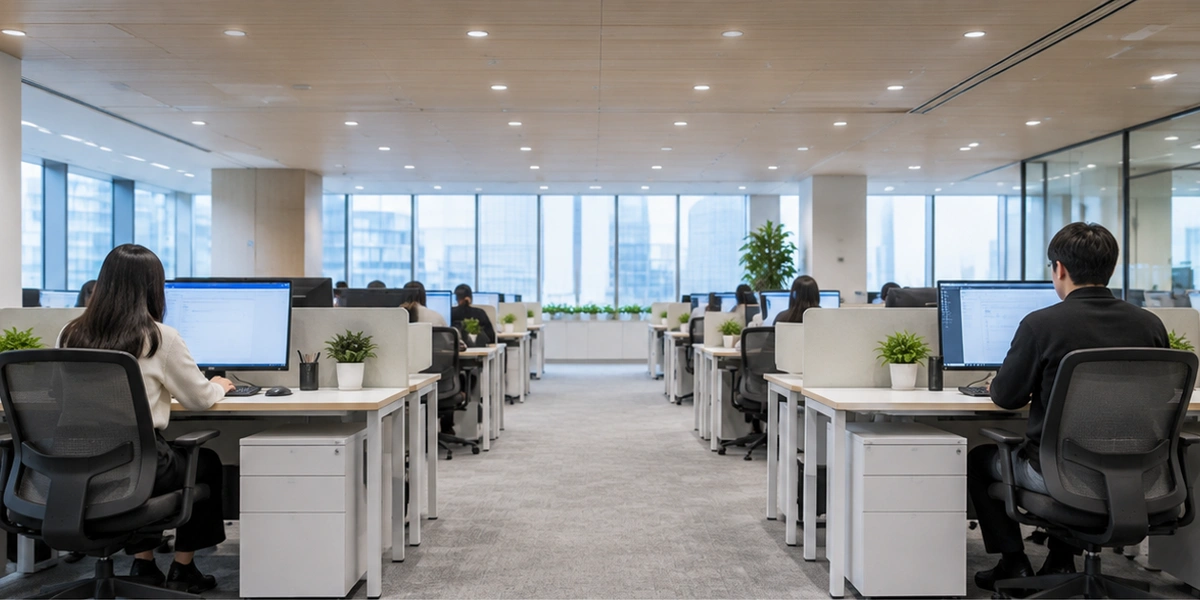
UGR Is a Room Score, Not a Lamp Stamp
The CIE 117 formula reads UGR = 8·log10((0.25/Lb)·Σ(L²·ω/p²)). Each symbol maps to something physical: Lb is the background luminance the eye adapts to, L is each fitting's luminance toward the observer, ω is how large that bright patch looks from the seat, and p is the Guth position index that discounts fittings far off the sightline. The logarithm mirrors human brightness perception, which is why the scale runs 10 to 30 in steps of 3 — each step is a just-noticeable jump in discomfort, not a fine decimal race.
Two calculation routes exist and they answer different questions. The tabular method grids one fitting type in a standard room (4H/8H proportions, 70/50/20 reflectances) and reports the worst wall-midpoint seat — handy for comparing optics side by side. DIALux point calculation instead drops a 1.2 m observer into your real model and sums every visible fitting, so partitions, dark timber ceilings and dense grids all count. Treat the table as a relative optic ranking and the simulation as the compliance answer; mixing the two up is where most UGR less than 19 disputes start.
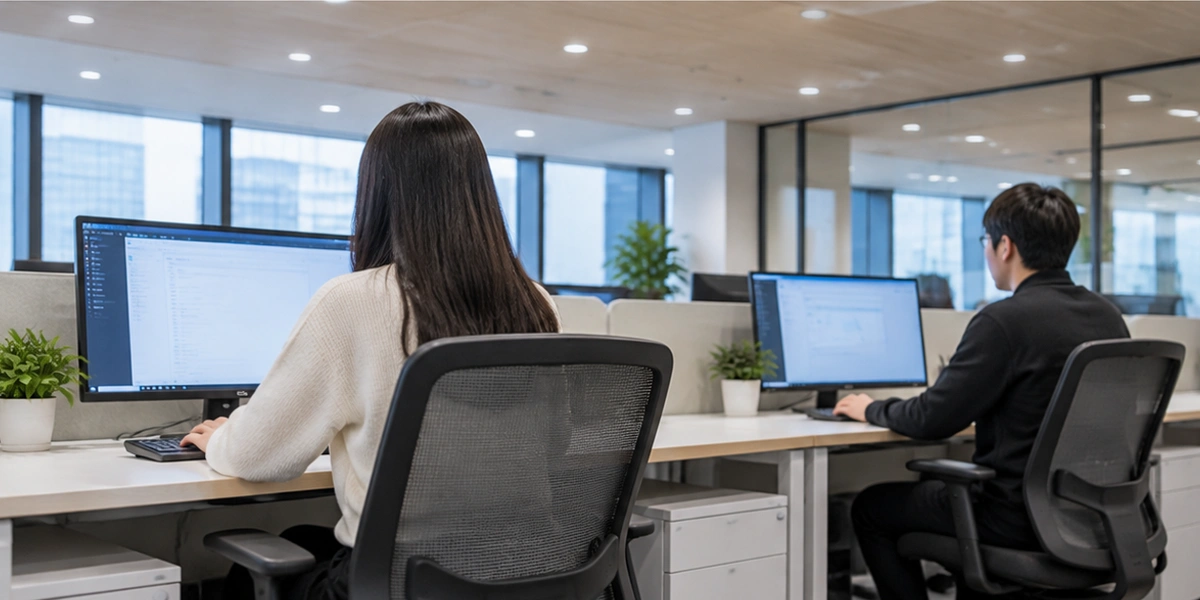
| Variable | What moves it on site | Effect on UGR |
|---|---|---|
| Lb background | Dark walls, black ceiling, low daylight | Lower Lb pushes UGR up |
| L luminance | Bare LED areas, shallow diffusers | Higher L pushes UGR up, squared |
| ω solid angle | Low ceilings, large luminous panels | Larger patch pushes UGR up |
| p position index | Fittings dead ahead of seated staff | On-axis fittings count most |
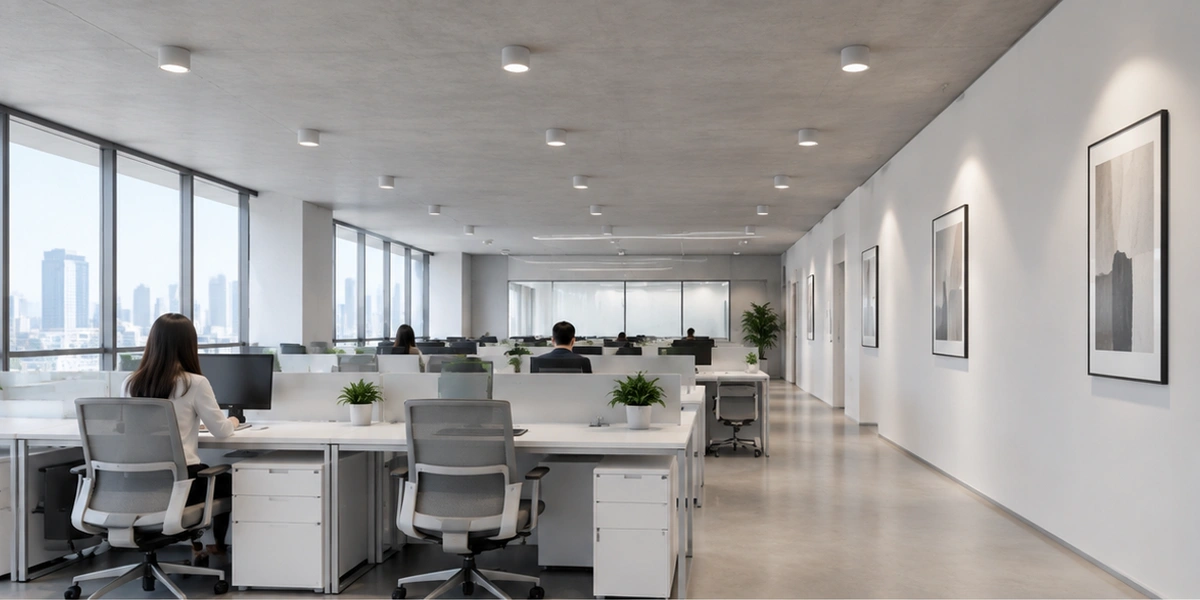
EN 12464-1 Limits Inspectors Actually Check
Europe's EN 12464-1 assigns each task a maintained illuminance, a UGR limit (RUGL) and a colour rendering floor. The office headline is simple: writing, reading and data processing need 500 lux at UGR 19 with Ra 80, meeting rooms match it, and technical drawing tightens to 750 lux at UGR 16. Classrooms and library reading areas sit at UGR 19, general retail sales at UGR 22 with till zones back at UGR 19, and corridors allow up to UGR 28. Note the pattern: finer or longer visual work gets the lower number.
| Space | Maintained lux | UGR limit |
|---|---|---|
| Office writing, reading, data processing | 500 | 19 |
| Meeting room, classroom, library reading | 300-500 | 19 |
| Technical drawing, CAD precision work | 500-750 | 16-19 |
| Retail sales area / till zone | 300 / 500 | 22 / 19 |
| Corridor, stairwell, warehouse coarse work | 100-150 | 25-28 |
Two footnotes save arguments at handover. First, the standard also caps luminaire luminance above 65 degrees toward screens, so a fitting can hold UGR 19 yet fail the screen-reflection clause over VDU desks. Second, limits apply to the maintained installation — aged, dusty fittings at full dimming are not the reference state. Ask the inspector which observer seats and which screen positions the report covers before debating a single decimal.
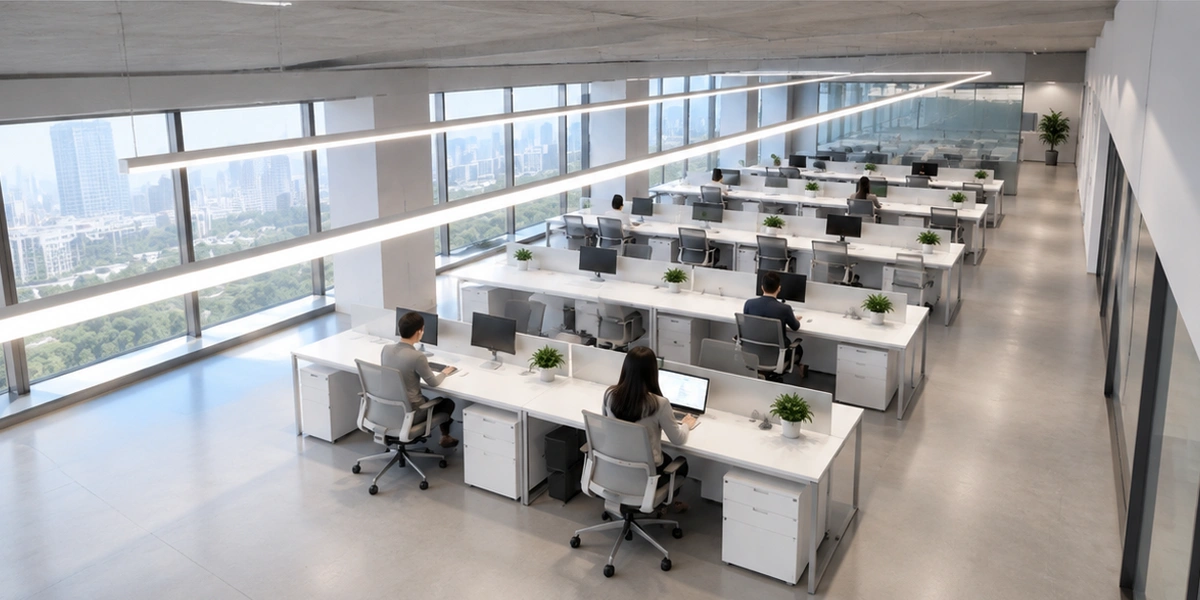
What Glare Does to People Over a Workday
Lighting research splits glare in two: discomfort glare annoys and aches without blinding, while disability glare scatters light inside the eye and measurably cuts visibility. UGR scores only the first, which is exactly why staff complaints and UGR printouts can disagree — the eye can be uncomfortable long before the task gets harder. Field studies keep returning the same symptom cluster: tired and dry eyes, trouble refocusing, headaches and a drift into awkward leaning postures that later surface as neck and shoulder pain.
The numbers behind that cluster are practical, not medical drama. A Cornell workplace trial found anti-glare screen filters cut reported tired eyes from 86 to 40 percent and headaches from 53 to 32 percent; a Norwegian reading trial under direct background glare showed significantly higher eye pain within 30 minutes plus elevated trapezius muscle load. The takeaway for designers: glare control buys sustained afternoon output, and its absence shows up first in the complaints log, not the lux meter. For the daylight side of the same comfort equation, see our daylight dimming companion that holds desk lux.
Seven Levers That Lower UGR
Every fix below traces back to the four formula symbols — shrink L and ω, lift Lb, or push fittings off-axis in p. Work through them in order during design; the retrofit section reuses the same list under site constraints.
- Deepen shielding — recess the source and raise the cut-off angle so seated eyes never see the bare LED patch.
- Enlarge the luminous area — trade one small hot aperture for a broader, dimmer face at equal lumens.
- Control high-angle output — specify lower candela above 60 degrees with louvers or microprismatic films.
- Brighten the background — lighter matte walls and ceilings lift Lb, the cheapest comfort gain in dark rooms.
- Raise and spread the grid — more fittings at lower individual lumens beat a few bright points.
- Aim off the sightline — keep beams off the seated viewing axis, especially over screen rows.
- Dim the peaks — trim maximum output where daylight or task tuning already covers the desk.
Failed Handover: the Four-Step Retrofit
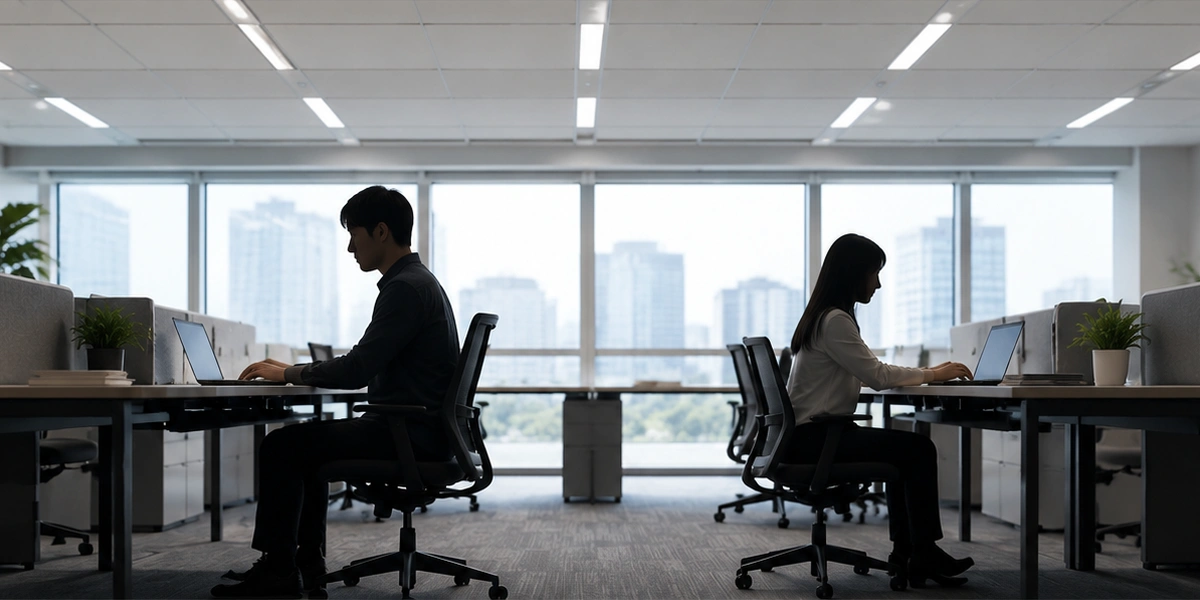
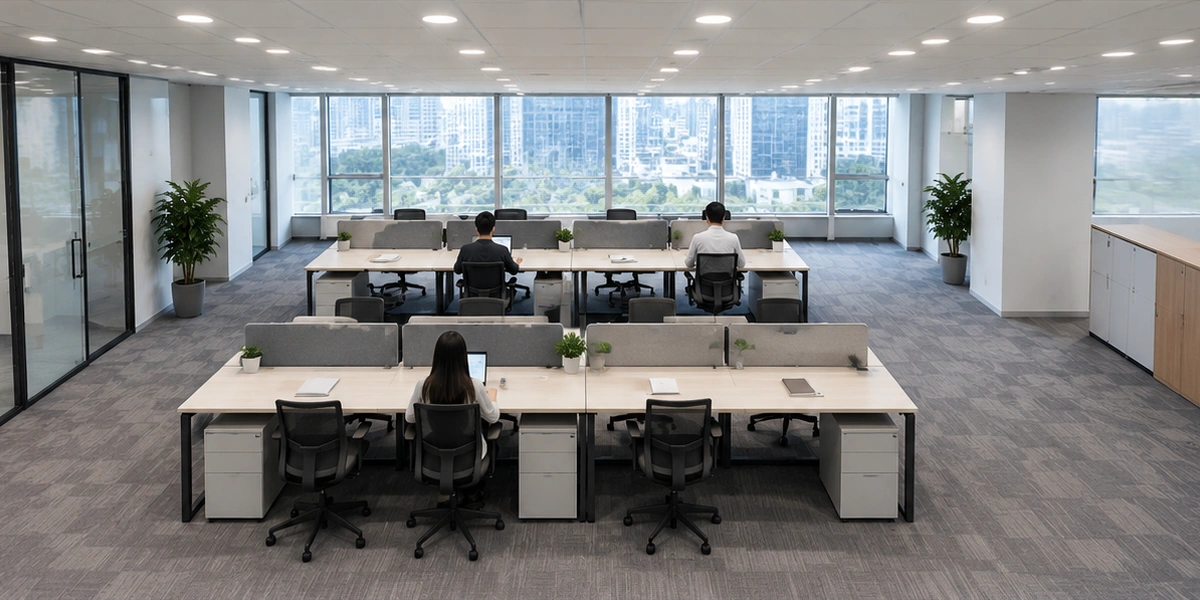
When the report lands above the limit, resist swapping fittings first. Step one is re-verification: confirm the observer seats, screen positions and reflectance assumptions in the model, because a single wrong wall finish can swing the result more than any optic. Step two is geometry: shift rows off the seated axis, split one long switching group into separately dimmed zones, and cap peak output where windows already deliver. Only at step three do optics change — deeper reflector rings, honeycomb louvers or micro-structure diffuser films that keep the housing and driver while taming high-angle candela.
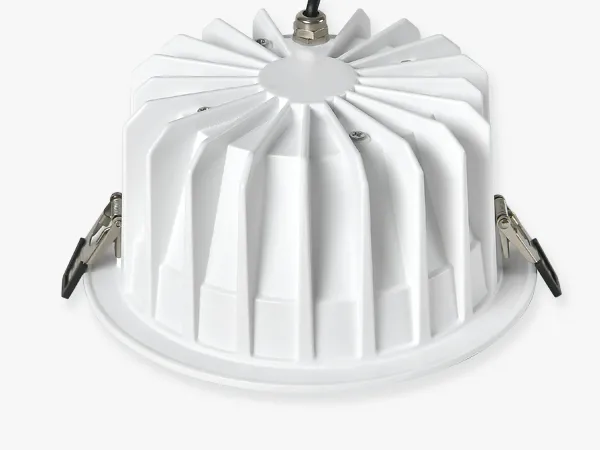
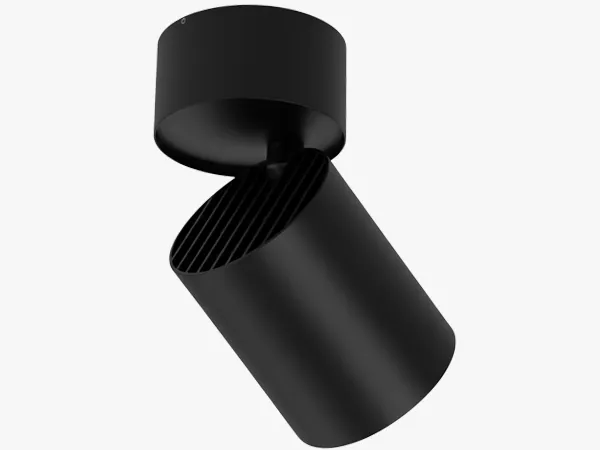
Step four is the like-for-like swap, and here cutout compatibility decides the budget. A family that holds one UGR22 comfort housing across 105 to 200 mm openings lets crews exchange heads overnight without touching ceilings, mixing narrower beams over fixed desk rows with wider beams in lounges. Solid-ceiling zones that cannot take a new hole get a surface head that tilts without a ceiling cutout instead. To size the replacement count before ordering, run the room through our fixture-count estimator for relighting math.

FAQ
Conclusion
A single UGR label never certifies a room, because UGR is scored from an observer's seat inside a finished space — its finishes, grid and sightlines included. Read catalogue values as optic rankings, prove compliance with a room-level simulation, and retrofit in order: verify assumptions, fix geometry, upgrade secondary optics, then swap like-for-like. Handled that way, glare control stops being a handover gamble and becomes one more verified line next to lux, uniformity and colour rendering. If the next layer after glare is scheduling those calmer scenes across the day, the scene scheduling guide for dimmed trading hours picks up where this guide stops.
Office UGR is a room score from a seated 1.2 m observer, not a lamp stamp: the CIE 117 formula weights each downlight by luminance, apparent size and Guth position index against background luminance. That is why a catalogue UGR 19 optic still needs a room-level check before it can hold 500 lux desks at UGR 19.
Sources
- According to the CIE, Discomfort glare in interior lighting (1995), UGR combines observer position and viewing direction with the Guth position index.
- Offices and classrooms hold UGR 19, drawing rooms UGR 16, sales floors UGR 22, corridors allow up to UGR 28.
Send Message
Fill out the form and we will get back to you as soon as possible