Low-CarbonIndustry News
Daylight Harvesting Dimming Guide for Supermarkets and Retail Stores
Introduction
This daylight harvesting dimming guide for supermarkets and retail stores answers the one question that decides whether skylights save or spoil sales: how does each luminaire dim itself as daylight rises and falls while keeping shelves at the lux the standard demands. In one line, daylight harvesting uses a ceiling photocell that sees daylight plus electric light and continuously trims driver output to hold a target lux, so produce stays warm and readable at 500 to 750 lux without over-lighting when the sun peaks. The supermarket daylight dimming with photocell closed-loop approach keeps that hold per fitting, not per floor, which is why our wireless dimming backbone for retail zones matters for the lux loop and the retail lighting solution with track and linear layers matters as the fixture family each zone dims — for time-based scenes versus daylight-based trim see this guide versus the five-scene schedule for Trading to Eco hours.
Why Daylight Harvesting Pays in Supermarkets
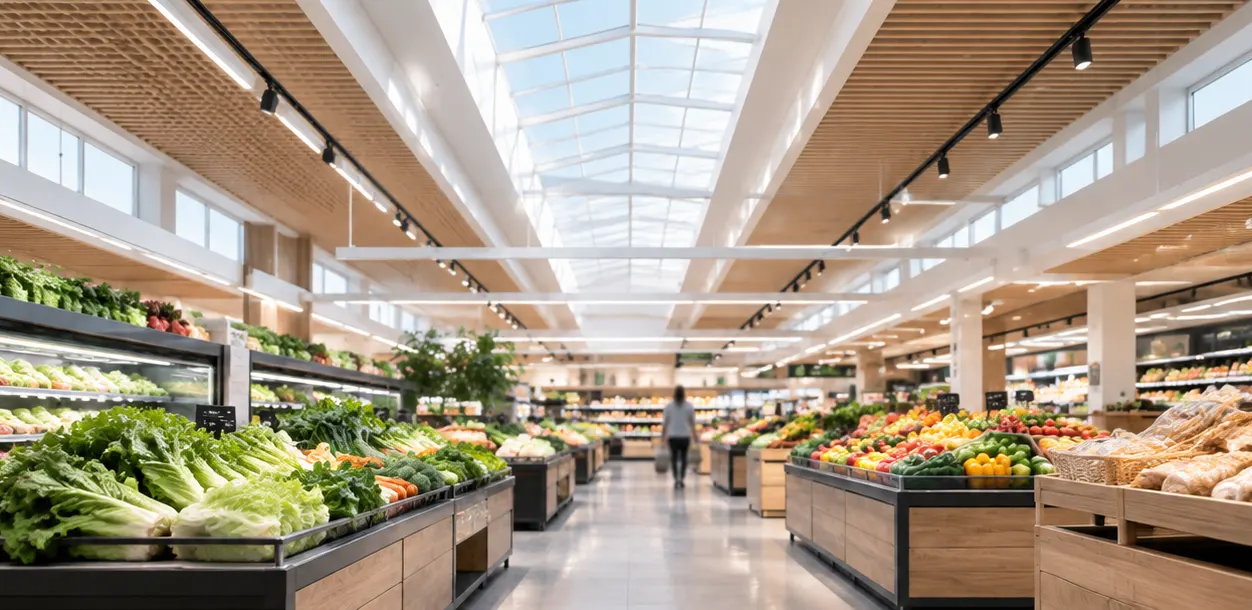
Supermarkets burn light more hours than any other retail format, often 14 to 24 hours with fresh counters lit from open to close. Produce, bakery and meat counters sit under high colour rendering at 300 to 750 lux, yet the roof above many produce halls is already part glass. Without harvesting, that free light adds on top of electric light and the store runs bright and wasteful at noon. With harvesting, the same 200 to 1000 light points of a 500 to 3000 m² format subtract daylight hour by hour while keeping the sales task at standard level.
- Daylight is free but uneven — inventory near clerestories can receive 500 lux from sky alone at midday and near zero after sunset; per-fitting dimming follows the gradient without dark corners.
- Lux hold protects sales — EN 12464-1 asks 300 lux on sales areas and higher on task counters; hold logic keeps counters inside that band instead of swinging 200 lux bright then 800 lux washed out.
- Energy signal is measured — LBNL meta-analysis averages about 28 percent lighting saving from daylight dimming and 24 percent from occupancy, with GSA federal sites averaging 27 percent from harvesting at simple payback near four years.
- Stack beats single layer — by-analogy to retail, combining daylight with occupancy and institutional tuning approaches about 38 percent combined, the same ceiling the BLE mesh stack targets when every produce bay has its own photocell.
That is why daylight harvesting is not a green add-on but a control quotient: the sales floor still looks fully lit to shoppers, yet the meter sees the photopic subtraction. For the eye that decides when an aisle is occupied, see the PIR vs microwave vs presence sensor guide for occupancy control.
How Supermarket Daylight Dimming with Photocell Closed-Loop Works
A photocell is simply a light sensor that returns a signal proportional to what it sees. Where it sits decides what it can hold. Open-loop places the sensor at the window looking out and estimates interior lux without ever seeing the electric light it controls. Closed-loop places the sensor on the ceiling looking down at the merchandise plane and sees daylight plus the electric light it is asked to regulate, feeding that sum back to the controller. For supermarkets, closed-loop per fitting wins because each bay sees a different mix of skylight, clerestory sidelight and track accent.
| Loop type | Where the photocell looks | What it measures | When to use in supermarkets |
|---|---|---|---|
| Open-loop | At window or clerestory, shielded from electric light | Daylight only | Early estimates or single-zone offices with one facade, not multi-bay produce halls |
| Closed-loop | On ceiling above bay, large field of view over workplane | Daylight plus electric light | Each produce, deli or aisle bay that must hold 500 to 750 lux as daylight moves |
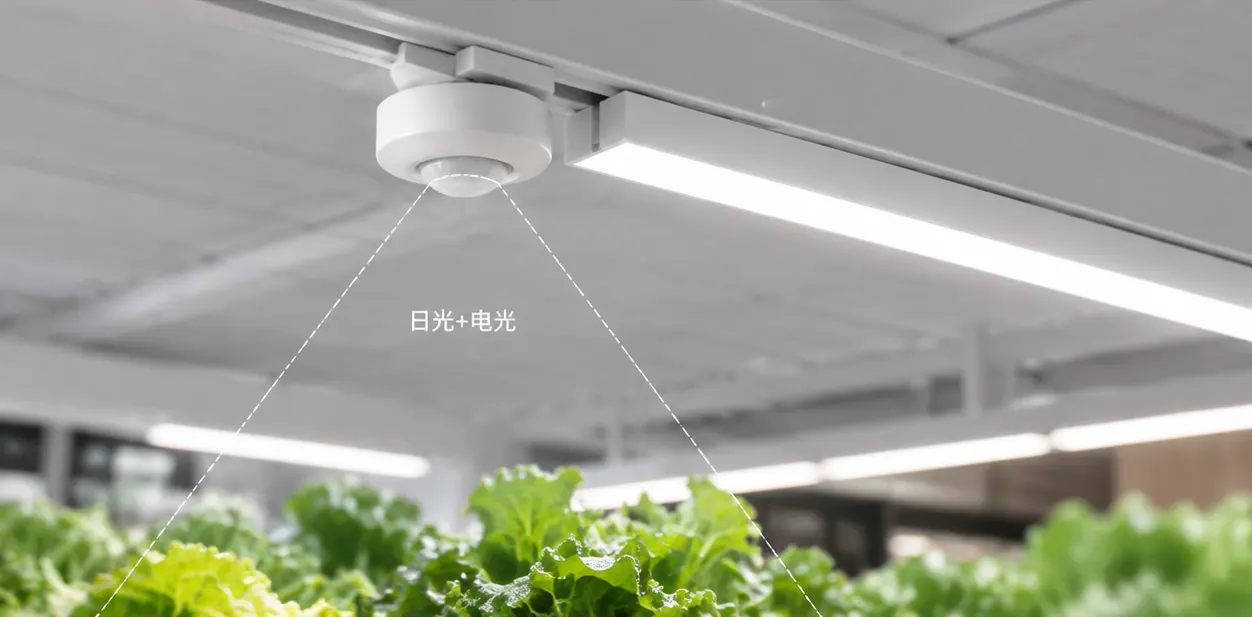
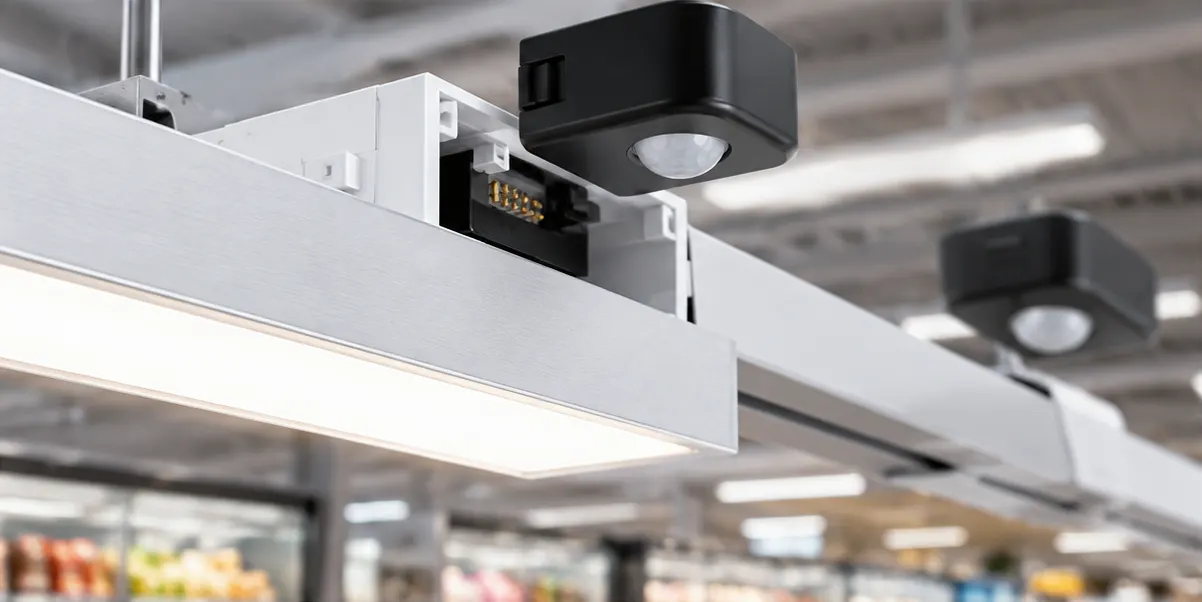
Commissioning sets the hold once: with shutters closed the installer aims drivers to the target lux, then opens daylight and the controller learns the daylight ratio. LBL testing on proportional closed-loop showed the best hold when the sensor has a broad view but is shielded from direct window glare, avoiding the oscillation that integral-reset loops suffered when tied to narrow hotspots. The D4i control devices with DALI Part 351 for luminaire-mounted sensors describe the modern bus-powered path for that per-fitting eye, and Zhaga Book 20 defines the socket that lets the same eye swap without opening the fitting.
Where Supermarkets Find Daylight for the Retail Store 28 Percent Saving
Not every supermarket is equally harvestable. The saving concentrates where the roof already invites sky. Produce halls under north-facing clerestories or linear skylights are the textbook daylight zone: shallow depth, high reflectance ceiling, and counters that face the sky. Side-lit perimeter bays near glass curtain walls and entrance lobbies are second, but depth falls fast beyond one window head height. Solid-roof aisles with no skylight remain electric-only and should not pretend to harvest.
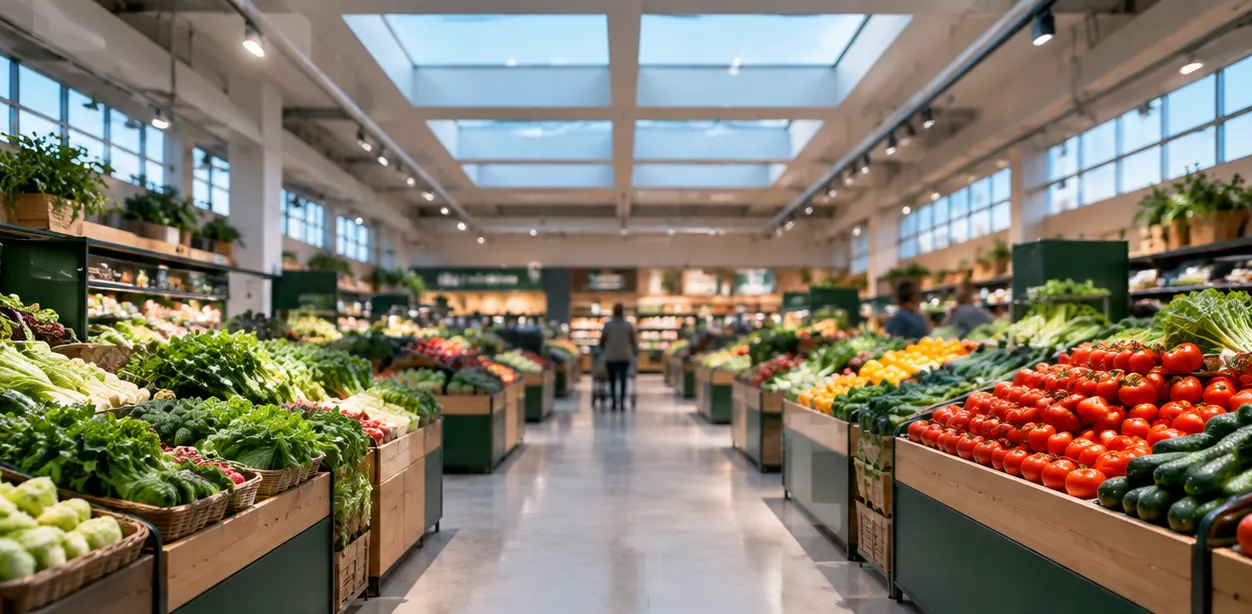
- Toplighting produce hall — 4 by 4 metre diffused units such as the Hannaford LEED Platinum market show, spread sky evenly; sidelighting clerestory adds morning and late afternoon without direct glare.
- Perimeter fresh walls — deli and bakery along glazed walls share a sidelit zone within one to one and a half window head heights; beyond that the photocell sees ceiling, not sky.
- Entrance and checkout throat — glass doors spill daylight seasonally; per-bay dimming prevents the first two bays driving the whole throat bright.
- No false zone — closed grocery aisles under solid metal deck are not daylight zones under ASHRAE or Title 24; they harvest only through occupancy, not photocell.
Designing Lux Hold to EN 17037 and EN 12464-1
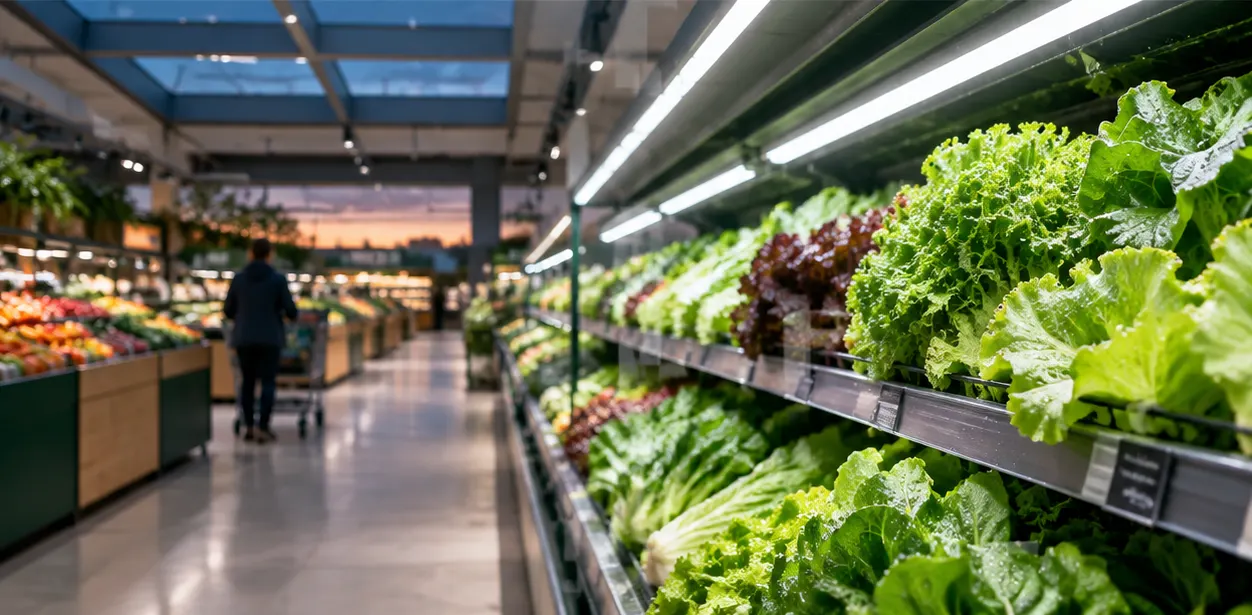
Two European norms set the numbers that daylight dimming must not violate. EN 17037 defines how much daylight a space should provide before electric light helps. EN 12464-1 defines how much maintained illuminance the electric light must keep on the task. Daylight harvesting lives between them: provide daylight when sky offers it, hold electric to the maintained task when it does not.
EN 17037 requires that at least half the reference plane reaches 300 lux for more than half the daylight hours, with at least 100 lux across 95 percent of the plane, verified by climate-based simulation or by daylight factor using median diffuse sky. For top-lit produce halls the target is 300 lux across the whole hall for that half-year horizon. That is the provision line harvesting must respect, not replace — daylight does the first 300 lux, electric tops to the retail task.
| Standard | Reference value for supermarket task | What daylight harvesting must do | Verification |
|---|---|---|---|
| EN 17037 daylight provision | 300 lux over 50 percent of plane, 100 lux over 95 percent for more than half daylight hours | Use toplighting and clerestory to meet provision passively, dim electric only above it | Climate simulation or daylight factor with local sky, annual 2190 hours check |
| EN 12464-1 sales area | 300 lux sales floor, 500 lux till and wrapper table, UGR 22, Ra 80 | Hold produce and fresh counters at 500 to 750 lux by closed-loop trim, floor at 300 lux | Maintained illuminance on task area per schedule, uniformity not below table limits |
| Supermarket practice overlay | Produce leafy 500 to 750 lux warm 2700 to 3000K, ambient general 30 to 50 foot-candles | Per-bay photocell keeps leafy band tight while ambient general tracks below it | Spot meter at counter height across depth from skylight, log dimming curve |
Practical calibration follows a short sequence: close daylight, set drivers to maintained lux per EN 12464-1; open daylight, read photocell signal proportional to task lux; choose target level as percentage of photocell range that equals maintained lux; set deadband around 10 percent to avoid hunting when clouds move; validate that frosted or tilted fixtures still keep uniformity above 0.6 on the bay.
What to Specify for Daylight Dimming Lux Hold in Produce Halls
Specification is where the 28 percent promise turns into a wiring choice. Supermarkets retail chains prefer refits without closing aisles, so wireless per-fitting eyes with 1 to 100 percent dimming win where ceilings stay shut. New builds under open deck can run wired DALI to each bay and still meet the same D4i data requirement. The TRIAC vs 0-10V vs DALI dimming guide for commercial lighting sorts the bus choice by wire and low-end flicker; this section sorts the daylight eye by socket and behaviour.
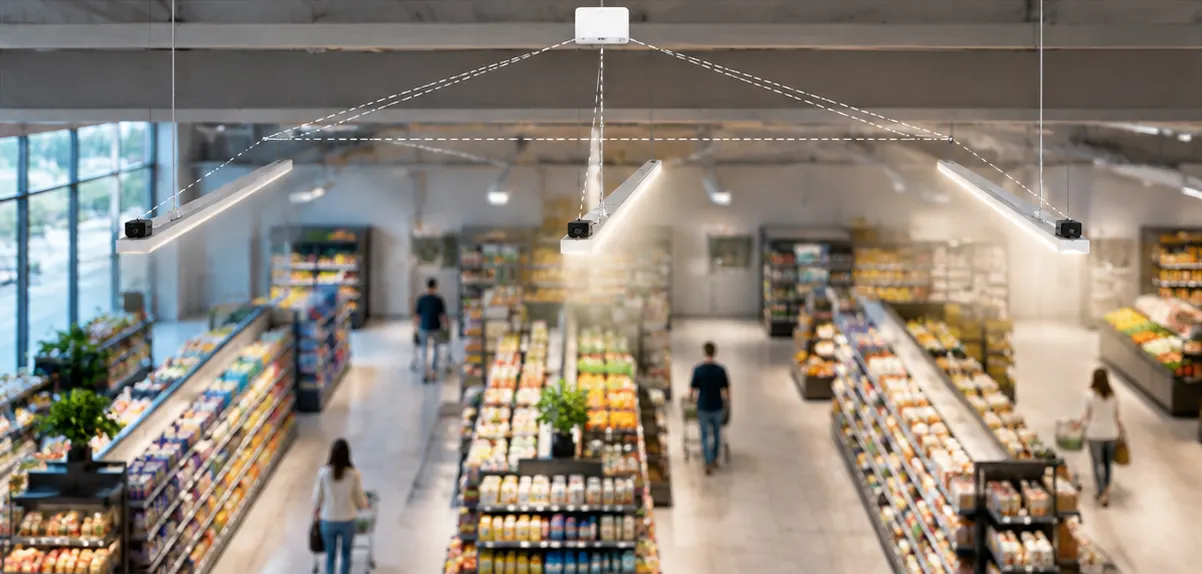
- One photocell per daylight bay — not one per store; a hall of six bays needs six closed-loop sensors facing the merchandise, each with its own target and deadband so the bay under the skylight trims deeper.
- D4i and Zhaga Book 20 socket — specify D4i drivers with Parts 251 to 253 data and a Book 20 slot for indoor luminaires, so a daylight and occupancy module swaps by plug without driver change, certified interoperable.
- BLE mesh or DALI per bay — BLE mesh where signal wiring is banned and 4000 nodes cover the estate with app grouping; DALI wired where 64 addresses per bus and 300 metre runs suit a new shell.
- 1 to 100 percent flicker-free span — proof points are VUE-S TR0103 20 to 32W at 145 lm/W 15 to 36 degrees, PANE-P LL1615 40 to 70W at 165 lm/W dual-panel, DL01-BLE 10 to 30W at 150 lm/W and FORT-A 80 to 200W at 170 lm/W — same mesh, same scene, different optic per bay.
- Commissioned target in lux, not percent — write “hold 500 lux on leafy produce, 300 lux on ambient aisle” and let the photocell target level be the percentage that equals it; percent alone drifts with fitting spacing.
FAQ
Conclusion
Daylight harvesting in supermarkets is not dimming everything by one photocell, it is holding each daylight bay at its EN 12464-1 lux while EN 17037 daylight provision does the first 300 lux. Closed-loop per fitting is the only loop that sees what shoppers see, toplight produce halls and clerestory perimeters are the only zones that pay, and D4i with Zhaga Book 20 is the socket that lets the eye stay interchangeable. Put the hold at 500 to 750 lux on leafy produce, keep a 10 percent deadband against cloud hunt, and let the 28 percent by-bay saving add to occupancy toward about 38 percent combined. For the clock that schedules the same bays after daylight fades, see the clock-driven scene schedule for night hours; for the wireless mesh that carries both the clock and the lux loop with no new signal wire, see the wireless mesh for schedules and daylight loops. Where the same bays also draw glare complaints at the till, the UGR-centred retrofit walkthrough for downlight grids explains the observer-seat check behind each limit.
Commissioning is a one-time daylight calibration: a closed-loop photocell with a broad but shielded view holds produce bays at 500 to 750 lux with about 10 percent deadband. That per-bay hold is what lets toplight halls bank the metered saving instead of swinging with clouds.
Sources
- According to the Lawrence Berkeley National Laboratory, Photoelectric Control of Daylight-Following Lighting Systems (1989), closed-loop proportional control with a shielded broad-view sensor holds the task level across daylight conditions.
- EN 17037:2018+A1:2021 daylight provision and EN 12464-1:2021 retail maintained lux set the hold targets for each daylight bay.
Send Message
Fill out the form and we will get back to you as soon as possible