Low-CarbonIndustry News
DALI D4i Energy and Diagnostics Monitoring Guide for Retail Lighting
Introduction
This DALI D4i energy and diagnostics monitoring guide for retail lighting answers the question chain operators ask after the compliance audit is filed: how do we read actual kilowatt-hours and catch a failing head before shoppers see a dark aisle. In one line, Part 251 gives each luminaire a passport, Part 252 meters its active energy on the driver and Part 253 logs its health counters, while a Zhaga Book 20 slot feeds occupancy and daylight diagnostics and a Part 341 gateway forwards all three reports to a wireless networked lighting control and on to the BMS. Compliance tells an auditor the building can report; this D4i Part 251 252 253 energy and diagnostics data guide tells facilities how to poll, store and act on that report across hundreds of stores. For the compliance layer that earns the EPBD Class A badge, see the DALI-2 D4i guide for Class A BACS compliance with Parts 250 to 253; for the daily scenes that this monitoring will measure, see the retail lighting scene scheduling guide with five scenes across three zones.
Why Per-Luminaire Metering Beats Sub-Meters for Retail Chains
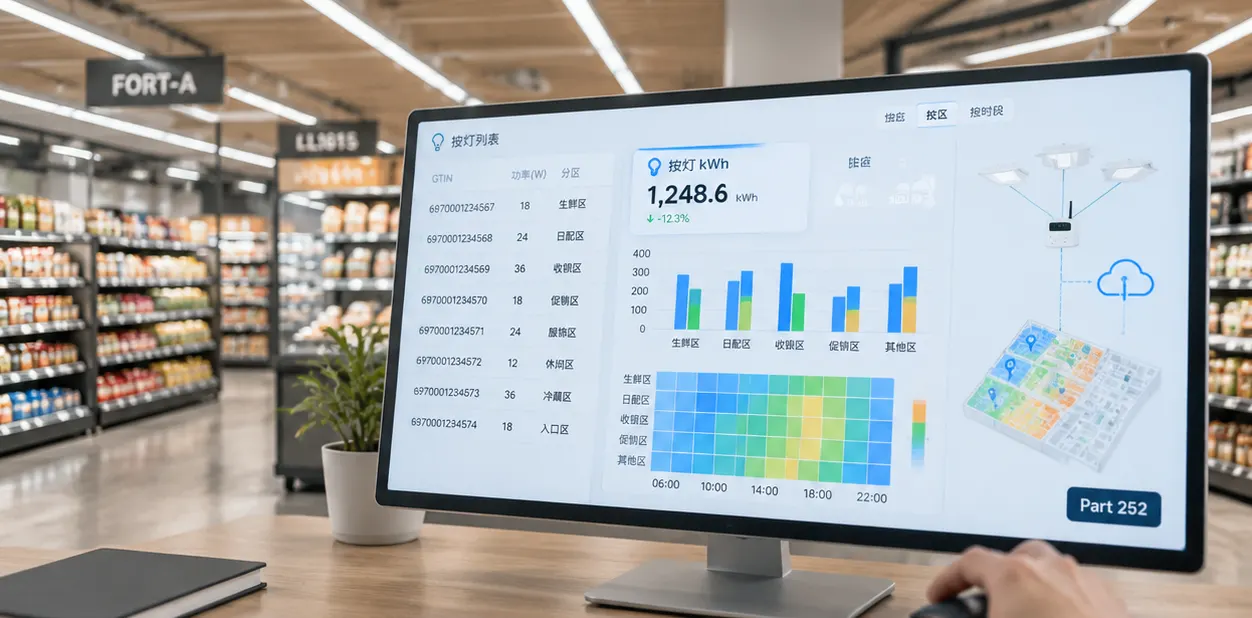
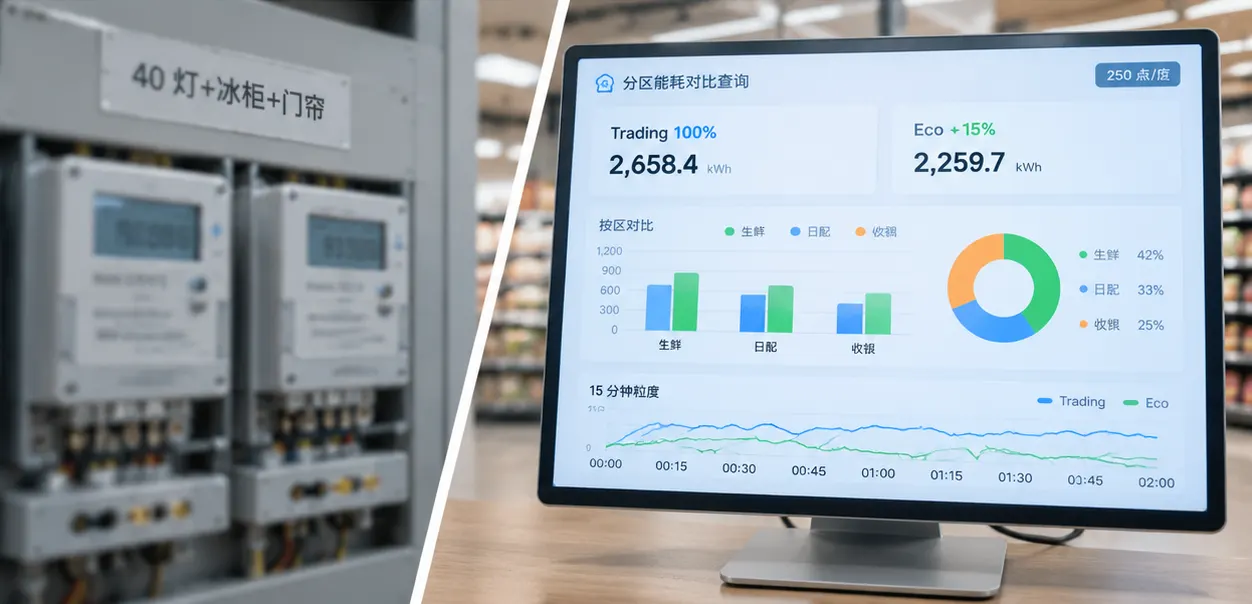
A retail estate does not lack meters; it lacks meters in the right place. A distribution board sees 40 luminaires plus a freezer plus a door heater on one breaker, so its kilowatt-hour cannot attribute cost to lighting or prove a dimming scene worked. Sub-metering each circuit helps, but a 250-point supermarket would need six to eight extra meters, CTs and commissioning hours that wireless refits forbid. DALI D4i flips the cost: the meter already lives in the driver, luminaire energy monitoring for retail chains reads active power and cumulative energy per driver without added hardware, and the BMS aggregates by zone, by store and by region with one query.
- One driver, one meter — Part 252 reports active power in watts and energy in watt-hours per driver, so the same 200 to 1000 points of a 500 to 3000 m2 format become 200 to 1000 sample points without a DIN rail.
- Chain roll-up without site visits — polling every 15 minutes keeps a 600-store estate searchable by aisle, by trading hour and by scene; daily kWh per square metre lands in the EMS for ISO 50001 without manual meter reads.
- Scene proof — comparing Trading 100% hours against Eco-Trading minus 15% is a query on the same Part 252 counter, not a before-after estimate.
- Maintenance signal — Part 253 run-time plus temperature rides with the same poll, so the heat that kills a driver shows before the light goes out.
ISO 52120-1 counts this as the data-collection layer of building energy management — logging, alarming and analysis that sits above the DALI bus but below the business report. Without it, Class A remains a certificate on the wall; with it, the BLE mesh wireless control solution for retail stores and the wired DALI segment share one accountable ledger.
Parts 250 to 253: What D4i Stores and Reports
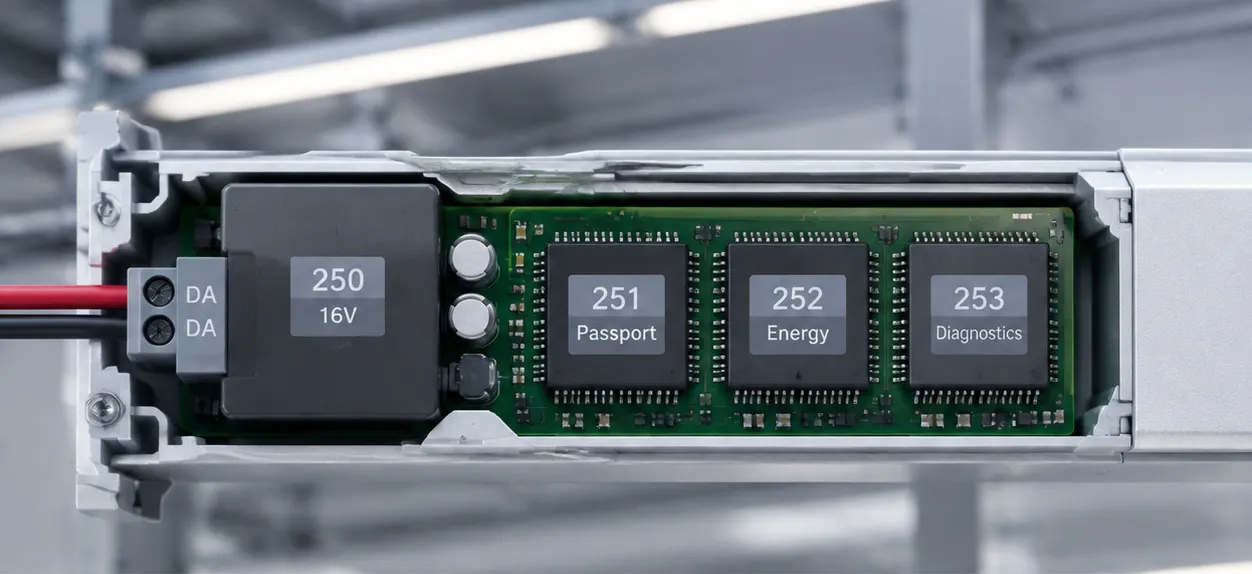
Read any D4i datasheet with this map: bus power plus three memory banks, all mandatory, all on the same DA/DA pair and all addressable through the standard data model that DiiA moved into IEC 62386-251 to 253 edition 2023. A DALI-2 driver may implement a subset; a D4i driver must implement all four and ship with its bus supply enabled, so a sensor can be bus-powered on day one.
| Part | Name / IEC 62386 | What it powers or stores | DALI-2 | D4i | Retail use |
|---|---|---|---|---|---|
| 250 | Integrated Bus Power | 16V bus supply inside driver for sensors | Optional | Mandatory on | Powers Zhaga Book 20 module, no 24V brick |
| 251 | Luminaire Data | Asset passport: GTIN, wattage, CCT, CRI, optics | Optional | Mandatory | Inventory and spares without opening ceiling |
| 252 | Energy Data | Active power and cumulative energy per driver | Optional | Mandatory | Per-luminaire kWh for billing and ESG |
| 253 | Diagnostics & Maintenance | Hours, starts, temperatures, failure flags | Optional | Mandatory | Predictive swap before dark aisle |
Energy accuracy itself is factory-declared and then tested under D4i certification, so audits can compare stores without calibrating each meter. On the bus, the data sits in memory banks 1 to 3 and is queried by the application controller or by the BLE mesh bulk commissioning guide for wiring-free pairing on live floors that now also carries sensor jobs. The normative definitions live in the DiiA D4i specifications Parts 250 to 253 and IEC 62386 transfers.
Zhaga Book 20: The Slot That Makes Sensor Diagnostics Interchangeable
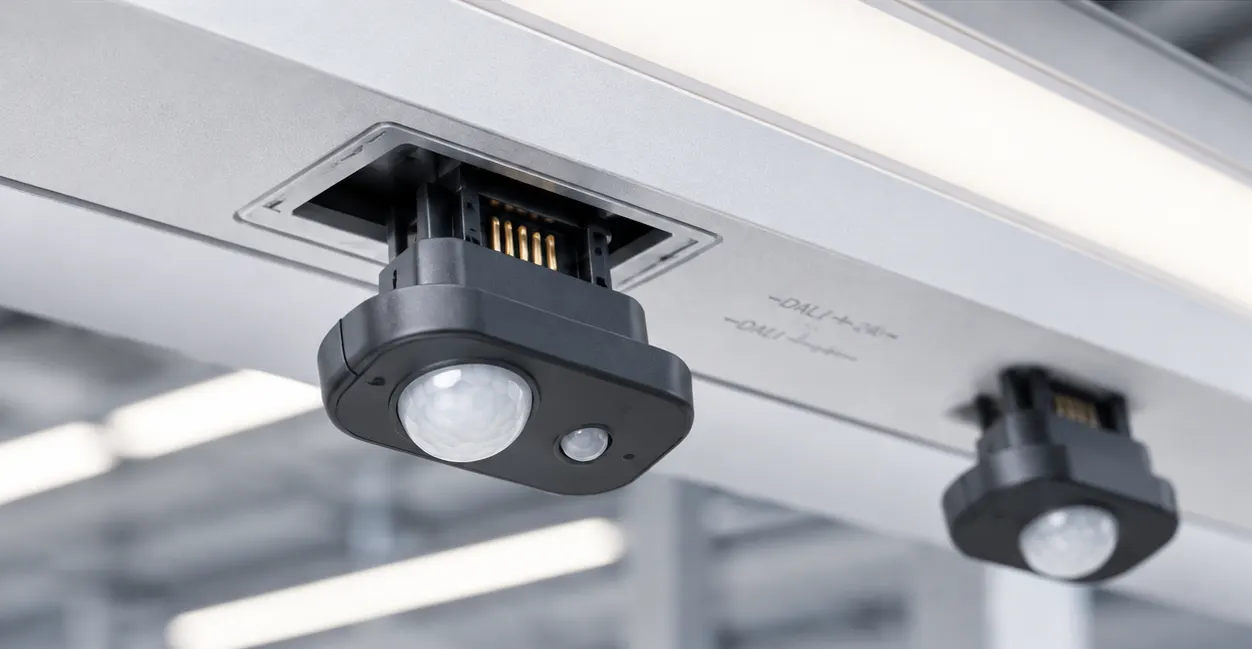
A driver with memory but no eyes can meter but cannot explain why a zone ran hot at noon. Zhaga Book 20 sensor diagnostics for retail stores fixes the geometry so the same D4i bus powers and reads the eye that explains it. Book 20 defines the indoor luminaire extension interface — a rectangular receptacle, a two-position connector and a D4i-plugged control device — so a PIR, a photocell or a combined head clicks on without custom wiring and without losing certification.
| Feature | Book 20 provision | What it means on a retail ceiling |
|---|---|---|
| Socket family | LEX-M module into LEX-S slot, R44x17 and R60x22 rectangular, C22 cylindrical legacy | Flat linear wash uses R44 low-profile, deep high-bay uses larger R60 for combined sensor |
| Fitting direction | Inside-mount, outside-mount and bracket outside-mount | Factory-sealed indoor linear versus site-swapped sensor on a high-bay without opening driver box |
| Electrical | DALI bus power + DALI communication over same pair, Poka-Yoke, 5N retention | No auxiliary 24V, no specialist rewire when swapping occupancy to daylight head |
| Certification | Type C or bus-powered Type D per Part 351, Zhaga-D4i dual mark | Interchangeable heads across vendors, same Part 253 diagnostics format |
| Diagnostics carried | Occupancy presence count, daylight lux, driver temperature via Part 351 control device | Heat and false-trigger counts travel with energy, not on a separate sensor bus |
For retrofit estates, this is the future-proof move: choose luminaires with a Zhaga Book 20 receptacle per the 2021 to 2022 edition 1.2 now, fit a low-cost PIR today for counting and occupancy saving, then swap to a dual PIR plus daylight head when the hall gains skylights — one click keeps the same DALI address, the same EMS tag and the same Zhaga Book 20 smart interface for indoor luminaires presentation.
From Bus to BMS: How Part 341 Gateways Carry Data
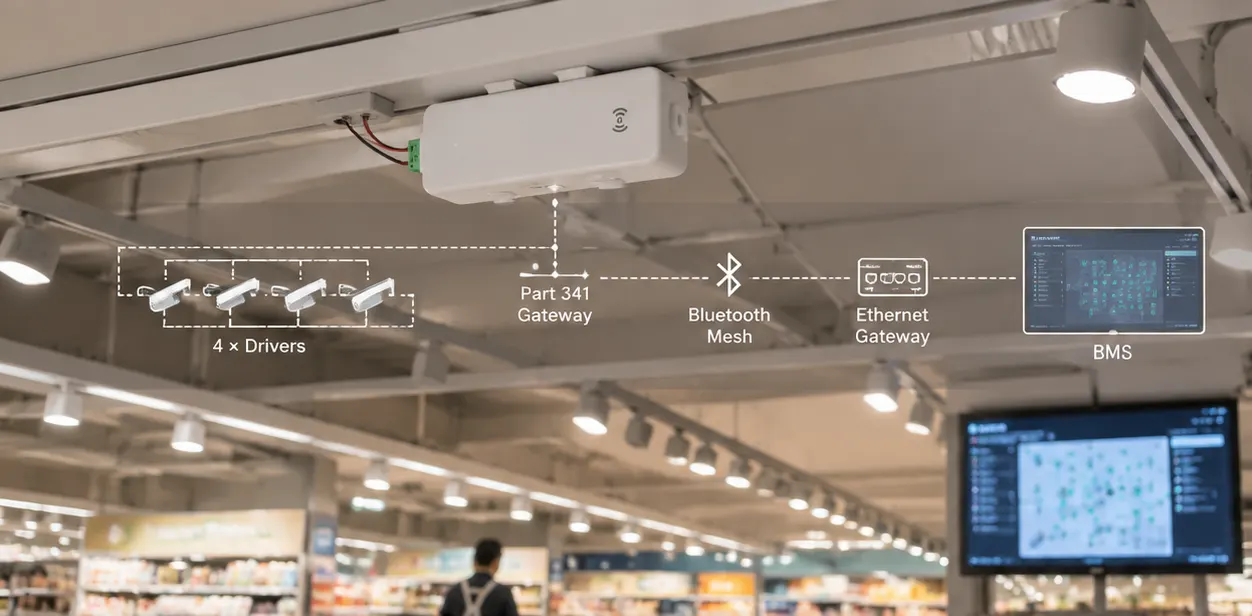
Retail chains rarely run a pure wired estate; supermarkets refit aisle by aisle, and ceilings must stay trading. The Part 341 NLC-DALI gateway is the bilingual clerk between the two worlds: on the wired side it is a DALI single or multi-master controller that queries D4i memory banks; on the wireless side it is a Bluetooth NLC mesh node that publishes the same bytes as native mesh sensor status.
- Four drivers per gateway — broadcast control of up to four control gear in one luminaire or small group over the DALI segment, enough for a four-head track or a linear run.
- Report forwarding — luminaire, energy and diagnostics data defined in Parts 251 to 253 travel via the gateway into the wireless ecosystem as if the driver were a native NLC device, plus lamp failure query.
- Control bidirectional — the NLC can also dim and recall scenes on the DALI drivers through the same gateway, so the schedule that dims Sales Floor Trading still runs from one app.
- BMS last mile — the mesh then southbounds over IP to the BMS or EMS via BACnet or REST, where EN ISO 52120-1 expects long-term trend storage for verification.
In practice, a store keeps its DALI-track accent wired, its BLE-mesh ambient wireless and one gateway per aisle marries the two — the comparison of PIR versus microwave versus presence logic for occupancy counts then feeds the same gateway as occupancy diagnostics. The normative gateway ability is documented in the DALI Alliance Wireless to DALI Gateways overview and Part 341 342 specifications, and the September 2021 technical guide maps single versus multi-master placements.
Operating Playbook for Retail Chains: Polling Cycles and Predictive Thresholds
Collecting data is not operating. The playbook below turns polls into tickets and kilowatt-hours into budgets — the layer auditors now check under the 2022 edition of EN ISO 52120-1 and under corporate ISO 50001 energy reviews.
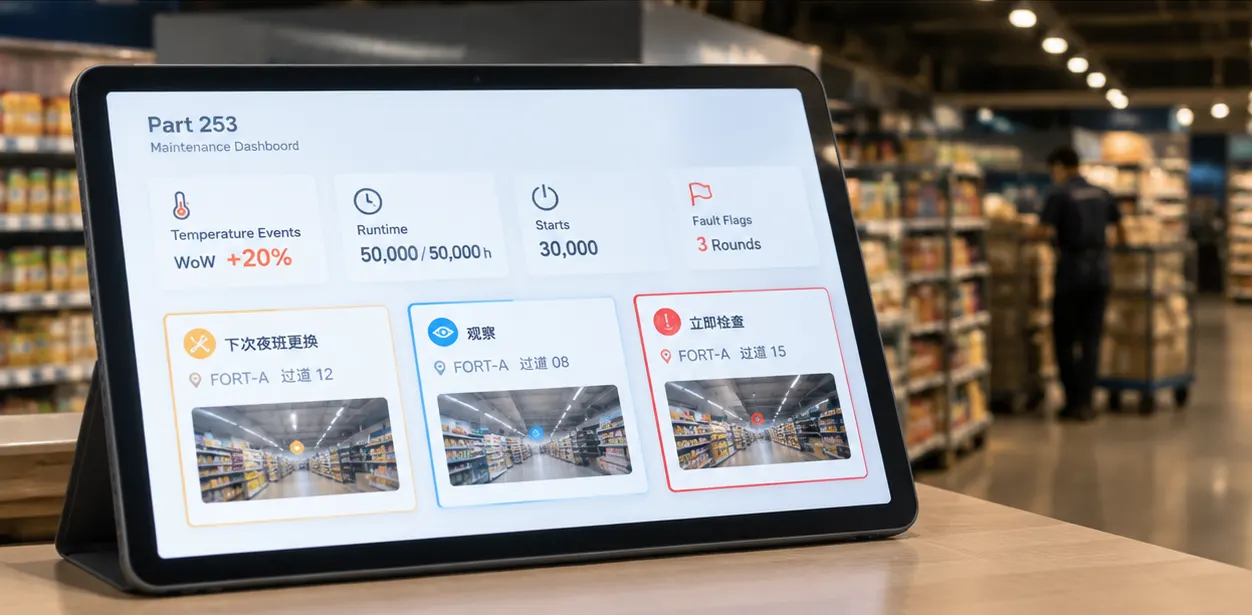
- Polling cadence — active power every 5 to 15 minutes, cumulative energy hourly, diagnostics nightly; on a 250-luminaire supermarket the bus stays well inside DALI frame limits while district aggregation runs at midnight.
- Storage shape — raw per-driver points for 30 days at 15-minute grain, hourly per-zone roll-ups for a year for Class A trend proof, daily per-store kWh per square metre for EMS KPIs.
- Predictive thresholds — flag driver over-temperature count up 20% week on week, operating hours above 50000 on an L80 50000-hour head, cumulative starts above 30000 on frequently switched accent, and lamp failure flag persisting across three polls; raise a planned work order for next night stocking, not an emergency call at opening.
- Scene versus daylight split — correlate Eco-Trading delta against daylight lux from the same Zhaga head; if lux is flat while kWh rises, the scene did not dim, not the sky.
- Multi-store heartbeat — publish online plus energy heartbeat per gateway to the estate NOC; a silent gateway means a store on local scenes but off cloud, trading safe but invisible — recall the offline-first recall of the daylight harvesting dimming guide closed-loop hold per bay versus the scheduled scene it measures.
The result reads like a well-kept till roll: each driver a line item, each store a till, each region a district. Procurement then buys heads by failure rate, not by gut feel, and the re-lamping round covers the predicted risers before Christmas peak.
The Fixtures That Prove This Monitoring Guide
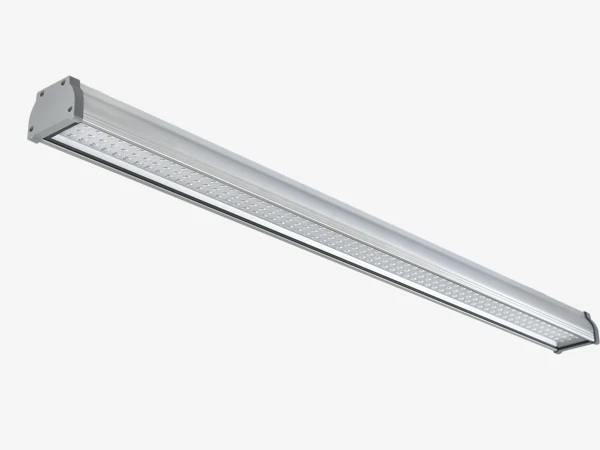
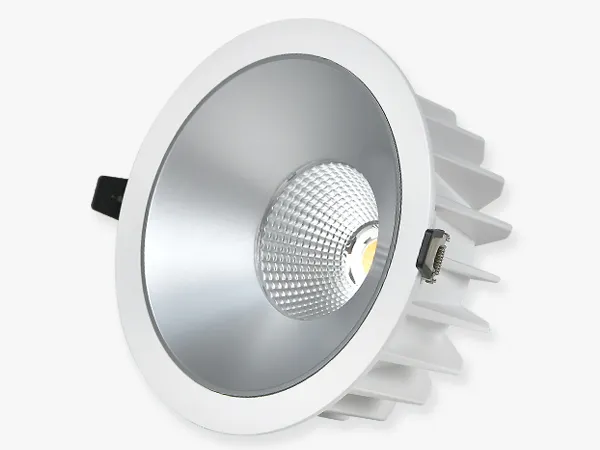
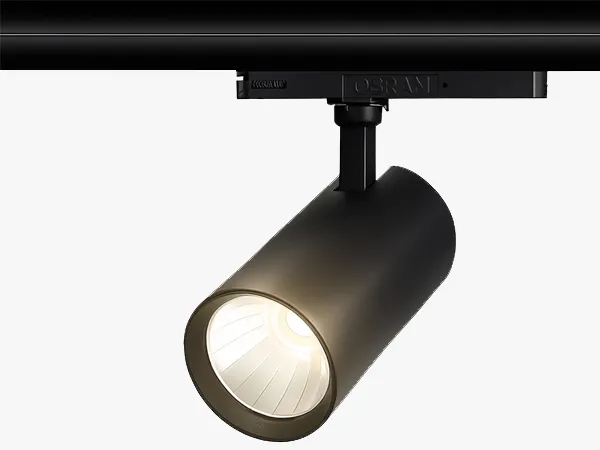
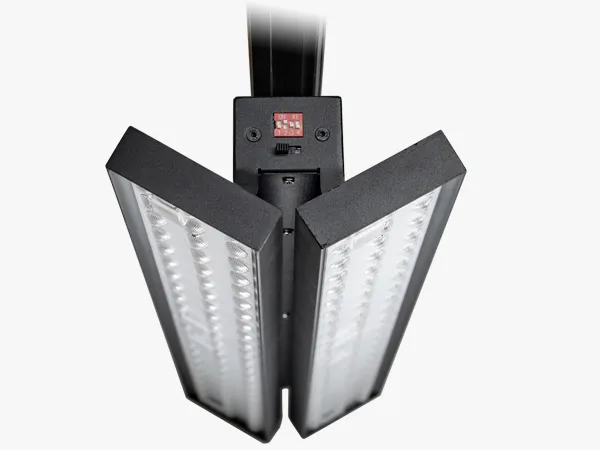
A monitoring guide without a shelf item is an app without a meter. The FORT-A at 80 to 200W up to 170lm/W, IP65 and IK08 with 50 by 100 degree lens and Zhaga-ready positions wires as the high-bay proof for dusty back-of-house and sales-floor per-aisle polling with DALI D4i drivers behind each bay. The VUE-S TR0103 at 20, 25 and 32W up to 4500lm at 145lm/W with 15, 24 and 36-degree beams covers the track accent that Part 252 measures per head when Trading recalls to 100%. The PANE-P LL1615 at 40 to 70W up to 11000lm at 165lm/W dual-panel and DL01-BLE at 10 to 30W up to 4300lm at 150lm/W with 4000-node BLE mesh cover aisle wash and ambient — one track point reports as a single D4i point, and the DL01-BLE gateway path carries D4i Reports into the mesh without opening ceilings. All four sit on the same data model; only the radio or the pair of wires differs, and the FORT-A DALI linear high bay for retail and warehouse chains anchors the store that rolls to region.
FAQ
Conclusion
Buy the meter that lives in the luminaire before the meter on the wall: D4i guarantees each driver can store its passport, meter its watt-hours and log its health, Zhaga Book 20 guarantees the sensor that explains the load clicks on, and Part 341 guarantees the same three reports reach a retail NLC and a BMS without a second wire. Poll power by quarter hour, roll energy by hour and flag heat by week, and maintenance becomes condition-based while ESG rolls become automatic. For the certificate that starts this chain, see the DALI-2 D4i guide for Class A BACS compliance versus this operations layer; for the scenes this ledger will prove, see the retail lighting scene scheduling guide with five retail scenes; and for the pairing that puts the ledger on the ceiling in one visit, see the BLE mesh bulk commissioning guide with three-tap binding on live floors.
Per-luminaire metering from Part 252 turns every driver into a meter, so a 250-point store polled every 5 to 15 minutes rolls hourly energy without added sub-meters. Diagnostics from Part 253 then flag heat and run-time early, so swaps happen on planned nights instead of dark aisles.
Sources
- According to the DiiA D4i specifications, Part 252 meters active power and energy per driver while Part 253 holds hours, starts, temperatures and failure flags for predictive maintenance.
- Zhaga Book 20 defines the indoor luminaire slot for interchangeable sensor heads, and Part 341 gateways forward Parts 251 to 253 reports into the wireless ecosystem toward the BMS.
Send Message
Fill out the form and we will get back to you as soon as possible